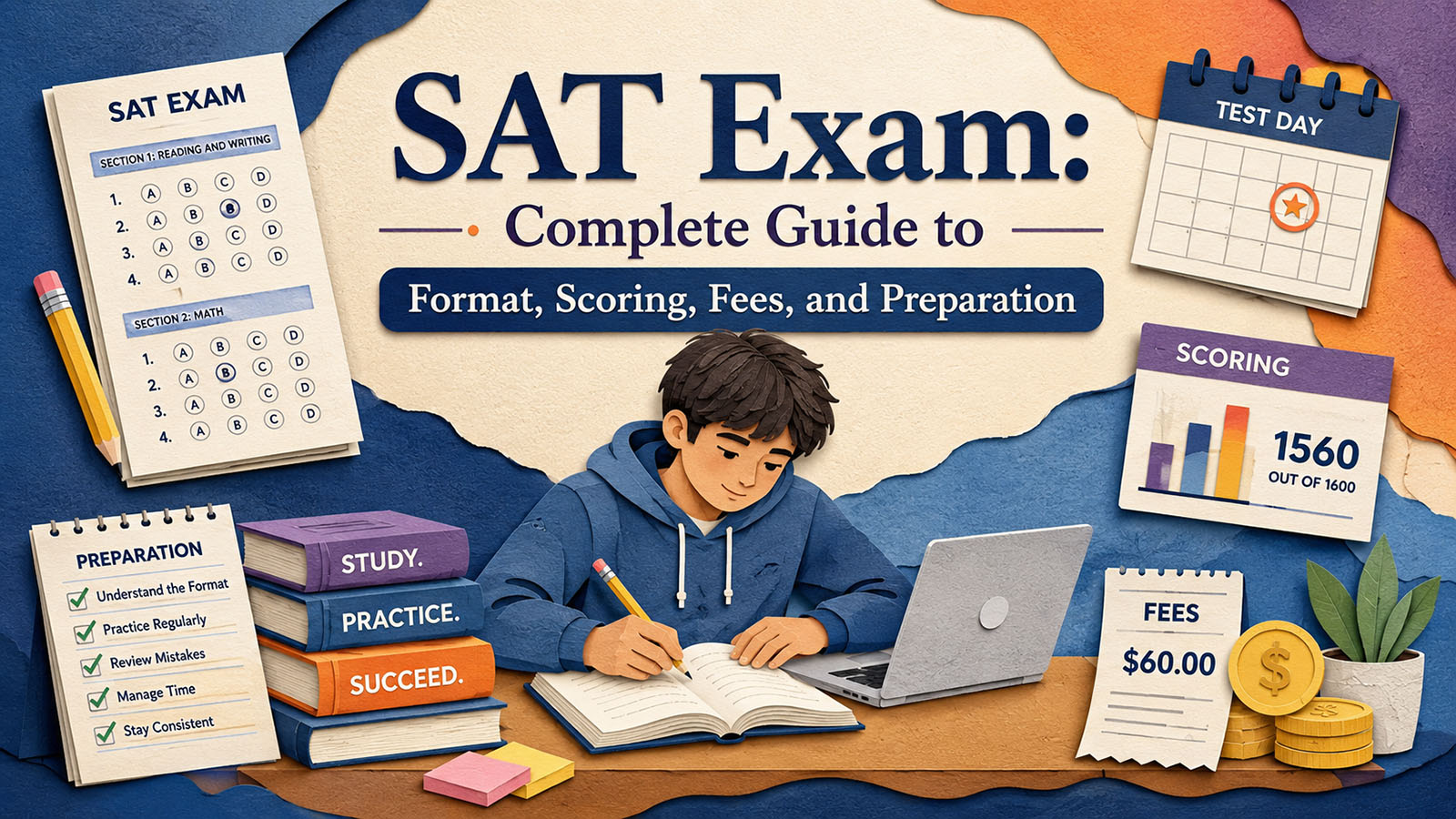
The SAT is a standardized test commonly used as part of the college admissions process in the United States. It measures skills in reading, writing, language, mathematics, data interpretation, and problem-solving.
Students can take the SAT when applying to colleges and universities that accept or consider standardized test scores. International students may also take the exam when applying to universities in the United States or other institutions that recognize SAT scores.
The SAT is administered by College Board and is now delivered digitally through the Bluebook testing application. The standard test contains two main sections, Reading and Writing and Math, and takes 2 hours and 14 minutes to complete, excluding the break.
This guide explains the SAT format, question types, scoring system, registration process, fees, test-day rules, and the most effective ways to prepare.
SAT Exam at a Glance
| Feature | Current SAT |
|---|---|
| Test format | Digital |
| Testing application | Bluebook |
| Main sections | Reading and Writing, Math |
| Total testing time | 2 hours and 14 minutes |
| Scheduled break | 10 minutes |
| Total questions | 98 |
| Reading and Writing questions | 54 |
| Math questions | 44 |
| Total score range | 400 to 1600 |
| Section score range | 200 to 800 |
| Question delivery | Multistage adaptive |
| Calculator use | Allowed throughout the Math section |
| Standard U.S. registration fee | $68 |
| Base international cost | $111 |
| Typical score release | 2 to 4 weeks |
The fees listed above are current through December 2026 and may change in future testing periods.
What Is the SAT Exam?
The SAT is designed to measure academic skills considered important for college-level study. It does not test every subject taught in high school. Instead, it focuses on a defined group of reading, writing, reasoning, and mathematical skills.
The test evaluates whether students can:
- Understand and analyze short written texts
- Interpret information from tables and graphs
- Identify evidence that supports a claim
- Understand words and phrases in context
- Apply English grammar and punctuation rules
- Improve the organization and clarity of a text
- Solve algebraic and nonlinear equations
- Analyze ratios, percentages, and data
- Solve geometry and trigonometry problems
- Apply mathematics to real-world situations
There is no pass or fail score for the SAT. Each student receives a score, and colleges decide how that score should be considered within their own admissions process.
Who Should Take the SAT?
The SAT is mainly taken by high school students who plan to apply to undergraduate programs.
Most students take their first SAT during the spring of their junior year or the beginning of their senior year. Taking the exam early enough gives students time to receive their results, identify weak areas, prepare again, and retake the test before college application deadlines.
College Board allows students to take the SAT as many times as they choose. It recommends taking the exam at least twice, commonly once during the spring of junior year and again during the fall of senior year.
International students may take the SAT when:
- Applying to a college or university in the United States
- Applying to an international university that accepts SAT scores
- Demonstrating academic readiness in an American-style admissions system
- Applying for scholarships that consider SAT performance
- Strengthening an application with an internationally recognized test score
Before registering, students should check the admissions policy of every university on their list. Some institutions require test scores, some recommend them, and others allow applicants to decide whether to submit them.
Is the SAT Digital?
The SAT is administered digitally through an application called Bluebook. Students normally take the test at an authorized school or test center using an approved laptop or tablet.
The digital SAT is not an online exam that students can take from home. Test takers must still attend an official testing location and follow supervised test-day procedures.
Supported devices include:
- Windows laptops and tablets
- Mac laptops
- iPads
- School-managed Chromebooks
Personal Chromebooks are not accepted. Bluebook must be installed before test day, and students must complete the exam setup process in advance.
Students who do not have access to a compatible device may request to borrow one from College Board. The request must generally be completed at least 30 days before the test date. Approval is not automatic, so students should submit the request as early as possible.
How Long Is the SAT?
The digital SAT takes 2 hours and 14 minutes, not including the scheduled break.
| Section | Modules | Questions | Time |
| Reading and Writing | 2 | 54 | 64 minutes |
| Math | 2 | 44 | 70 minutes |
| Total | 4 | 98 | 134 minutes |
Students receive a 10-minute break between the Reading and Writing section and the Math section.
Each Reading and Writing module lasts 32 minutes. Each Math module lasts 35 minutes.
Students can move backward and forward between questions within the current module. They can also mark questions for review and change their answers before the module ends. However, once a module has ended, they cannot return to it.
How Does the Adaptive SAT Work?
The digital SAT uses multistage adaptive testing.
Both the Reading and Writing section and the Math section are divided into two modules.
The first module contains a combination of easier, medium, and more difficult questions. The difficulty of the second module is influenced by the student’s performance in the first module.
A student who performs strongly in the first module will usually receive a more difficult second module. A student who has more difficulty in the first module will generally receive a less difficult second module.
This does not mean that the second module contains only easy or difficult questions. Each version still includes questions of mixed difficulty.
The final section score is based on performance across both modules. Students should therefore answer every question carefully, especially during the first module.
Can Two Students Receive Different SAT Questions?
Yes. Because the exam is adaptive, two students taking the SAT on the same date may receive different second modules or different combinations of questions.
College Board uses statistical scoring methods to account for differences in question difficulty. A student’s score is not simply the percentage of questions answered correctly.
Does Getting an Easier Second Module Limit Your Score?
The difficulty path can affect the range of scores a student can achieve. A student who receives the more challenging second module has demonstrated stronger performance in the first module and has access to questions that can support a higher section score.
However, receiving a difficult second module does not guarantee a high score. Students must still answer the questions correctly.
SAT Reading and Writing Section
The Reading and Writing section contains 54 questions and lasts 64 minutes. It is divided into two modules of 27 questions and 32 minutes each.
Unlike the former paper SAT, which used several long passages followed by multiple questions, the digital SAT generally presents a short passage or pair of passages followed by one multiple-choice question.
Passages are usually between 25 and 150 words and may relate to:
- Literature
- History
- Social studies
- Humanities
- Science
Some questions also include tables, bar charts, or line graphs.
The section tests four main content domains.
1. Information and Ideas
Information and Ideas questions measure reading comprehension, analysis, and evidence-based reasoning.
Students may need to:
- Identify the main idea of a passage
- Select an important supporting detail
- Make a logical inference
- Identify evidence that supports a conclusion
- Interpret information in a table or graph
- Combine information from a text and an informational graphic
These questions require students to understand what a passage says directly and what can reasonably be concluded from it.
2. Craft and Structure
Craft and Structure questions focus on vocabulary, purpose, text organization, and relationships between texts.
Students may be asked to:
- Determine the meaning of a word in context
- Explain the purpose of a sentence
- Identify the function of part of a passage
- Compare two related texts
- Analyze an author’s reasoning
- Recognize how a passage is organized
Memorizing long lists of rare words is usually less useful than learning how meaning changes according to context.
3. Expression of Ideas
Expression of Ideas questions test a student’s ability to revise and organize written information effectively.
Common tasks include:
- Selecting the best transition
- Combining notes to achieve a particular writing goal
- Choosing information relevant to a purpose
- Improving the logical flow of ideas
- Selecting the clearest and most precise sentence
Some questions provide a list of notes and ask the student to use those notes to meet a specific rhetorical goal.
4. Standard English Conventions
Standard English Conventions questions focus on grammar, sentence structure, usage, and punctuation.
Students should understand:
- Complete and incomplete sentences
- Independent and dependent clauses
- Subject-verb agreement
- Pronoun agreement
- Verb forms and tense
- Modifiers
- Possessives
- Commas
- Semicolons
- Colons
- Apostrophes
- Sentence boundaries
The Reading and Writing section tests these four domains across both modules.
SAT Math Section
The Math section contains 44 questions and lasts 70 minutes. It is divided into two modules of 22 questions and 35 minutes each.
Most Math questions are multiple-choice. Some are student-produced response questions, which require students to enter their own answer rather than select an option.
Approximately 30 percent of the Math questions are presented in a real-world, scientific, or social-science context.
The Math section covers four main areas.
1. Algebra
Algebra is one of the largest parts of the SAT Math section. It mainly covers linear equations, linear functions, and systems of equations.
Students should be able to:
- Solve linear equations in one variable
- Solve systems of two linear equations
- Work with linear inequalities
- Interpret slope and intercepts
- Create equations from written information
- Analyze linear functions
- Connect equations, graphs, and tables
There are normally around 13 to 15 Algebra questions.
2. Advanced Math
Advanced Math focuses on nonlinear equations and expressions.
Topics may include:
- Quadratic equations
- Exponential functions
- Polynomial expressions
- Rational expressions
- Radical equations
- Nonlinear systems
- Function notation
- Equivalent expressions
- Zeros and factors of polynomials
- Graphs of nonlinear functions
There are normally around 13 to 15 Advanced Math questions.
3. Problem-Solving and Data Analysis
This category measures quantitative reasoning and the ability to interpret data.
Students may encounter:
- Ratios
- Rates
- Proportions
- Percentages
- Unit conversions
- One-variable data
- Two-variable data
- Scatterplots
- Probability
- Sampling
- Statistical claims
- Measures of center and spread
There are usually around 5 to 7 questions from this category.
4. Geometry and Trigonometry
Geometry and Trigonometry questions may cover:
- Lines and angles
- Triangles
- Similarity
- Right triangles
- Circles
- Area
- Volume
- Coordinate geometry
- The Pythagorean theorem
- Basic trigonometric ratios
- Radians and degrees
There are usually around 5 to 7 Geometry and Trigonometry questions.
Can You Use a Calculator on the SAT?
Students may use a calculator throughout the Math section.
Bluebook includes an embedded Desmos calculator that can be switched between scientific and graphing modes. Students may also bring an approved handheld calculator.
A personal calculator is not required, but it can be useful when a student is already familiar with its controls and functions.
Under the calculator policy effective since August 2025, calculators with computer algebra system functionality are prohibited. Calculators cannot have symbolic algebra functions, QWERTY keyboards, wireless communication, cameras, or audio and video recording capabilities.
Students cannot use a handheld calculator during the Reading and Writing section.
What Tools Are Available in Bluebook?
The Bluebook application includes several testing tools:
- A countdown timer
- A question navigation menu
- A mark-for-review function
- An annotation tool
- An answer-elimination tool
- A Math reference sheet
- An embedded calculator
- Zoom controls
Students should complete at least one full-length practice test in Bluebook before the real exam. Knowing how to use the application prevents valuable time from being lost on test day.
How Is the SAT Scored?
The SAT total score ranges from 400 to 1600.
It is calculated by adding two section scores:
| Score | Range |
| Reading and Writing | 200 to 800 |
| Math | 200 to 800 |
| Total SAT score | 400 to 1600 |
The SAT does not use a simple rule in which every correct answer is worth a fixed number of points. The scoring system considers factors such as question difficulty and the adaptive route taken through the exam.
Some questions are pretest questions used to evaluate material for future exams. These questions do not count toward the final score, but students cannot identify them during the test. College Board states that each module contains operational questions and two unscored pretest questions.
Is There a Penalty for Guessing?
There is no separate penalty for an incorrect answer. Students should answer every question, even when they are uncertain.
When time is limited, students should eliminate clearly incorrect answers, make their best choice, and move on. They can mark the question for review and return to it if time remains within the module.
What Is a Good SAT Score?
A good SAT score depends on the colleges, programs, and scholarships to which a student is applying.
College Board describes the average SAT score as approximately 1050 and identifies a score of 1350 or higher as being within the top 10 percent of test takers. These figures should be treated as general reference points rather than universal admissions targets.
A practical way to establish a target score is to:
- Make a list of intended colleges.
- Find the SAT score range of recently admitted students.
- Identify the middle 50 percent range for each institution.
- Aim for a score near or above the upper end of that range.
- Check whether specific scholarships have minimum score requirements.
A score that is strong for one university may be below the normal range at another.
SAT College Readiness Benchmarks
College Board reports college and career readiness benchmarks of:
- 480 for Reading and Writing
- 530 for Math
These benchmarks are intended to indicate whether a student is on track for success in related entry-level college courses. They are not admissions cutoffs.
Do Colleges See Every SAT Score?
College Board offers Score Choice, which allows students to choose which test dates to send to colleges.
Students choose scores by complete test date. They cannot send only the Math score from one test date without also sending the Reading and Writing score from that same date.
Some colleges and scholarship programs require applicants to report all SAT attempts, so students must check each institution’s policy before using Score Choice.
What Is SAT Superscoring?
Some colleges use superscoring. This means they combine a student’s highest Reading and Writing score and highest Math score, even when those scores were earned on different test dates.
For example:
| Test date | Reading and Writing | Math | Total |
| First test | 690 | 650 | 1340 |
| Second test | 660 | 720 | 1380 |
| Superscore | 690 | 720 | 1410 |
Superscoring policies are determined by individual institutions. Students should not assume that every college uses this method.
When Are SAT Scores Released?
Most weekend SAT scores are released within 2 to 4 weeks after test day. College Board publishes exact score release dates for each administration.
For the fall 2026 weekend exams, the scheduled releases are:
| Test date | Scheduled score release |
| August 22, 2026 | September 4, 2026 |
| September 12, 2026 | September 25, 2026 |
| October 3, 2026 | October 16, 2026 |
| November 7, 2026 | November 20, 2026 |
| December 5, 2026 | December 18, 2026 |
Scores may occasionally be delayed because of administrative reviews, testing irregularities, or account issues.
How to Send SAT Scores to Colleges
Students can select up to four organizations to receive their scores without an additional score-report fee. These recipients can be selected during registration or changed until nine days after the test.
After that period, additional score reports currently cost $15 each. Rush reporting and other score services have separate charges.
Students should allow enough time for:
- College Board to release the score
- College Board to process the score order
- The institution to receive and match the score to the application
A student should not schedule the SAT too close to a college application deadline.
How to Register for the SAT
Students register through their College Board account.
The general registration process is:
- Create or sign in to a College Board account.
- Enter personal and school information.
- Select a test date.
- Search for an available test center.
- Upload an acceptable registration photo.
- Choose whether a device is available.
- Request a loaned device when necessary.
- Select score recipients, if desired.
- Pay the registration fee or enter fee-waiver information.
- Review and submit the registration.
The name and other identifying information in the account should match the student’s physical identification document.
As the test approaches, students must open Bluebook and complete exam setup. This process generates the admission ticket, normally between one and five days before the test.
SAT Test Dates for 2026 and 2027
The confirmed weekend SAT dates from August 2026 through June 2027 are:
| Test date | Regular registration deadline | Late registration deadline |
| August 22, 2026 | August 7, 2026 | August 11, 2026 |
| September 12, 2026 | August 28, 2026 | September 1, 2026 |
| October 3, 2026 | September 18, 2026 | September 22, 2026 |
| November 7, 2026 | October 23, 2026 | October 27, 2026 |
| December 5, 2026 | November 20, 2026 | November 24, 2026 |
| March 6, 2027 | February 19, 2027 | February 23, 2027 |
| May 1, 2027 | April 16, 2027 | April 20, 2027 |
| June 5, 2027 | May 21, 2027 | May 25, 2027 |
These dates apply to both U.S. and international weekend testing. Deadlines expire at 11:59 p.m. U.S. Eastern Time. Dates and deadlines may change, so students should verify them before registering.
Students requesting a loaned device should register and submit their request at least 30 days before the test.
How Much Does the SAT Cost?
As of July 2026, the standard SAT registration fee in the United States is $68.
Students taking the exam internationally pay:
- $68 registration fee
- $43 international fee
- Total base cost of $111
Some international test centers charge an additional $24 test-center fee.
Additional SAT Fees
| Service | Fee through December 2026 |
| Late registration | $38 |
| Change test center | $34 |
| Regular cancellation | $34 |
| Late cancellation | $44 |
| Additional score report | $15 |
| Rush score report | $31 plus applicable report fees |
| Archived score request | $35 plus applicable report fees |
| Score verification | $55 |
Students should check the current fee page before paying because prices may change after December 2026.
SAT Fee Waivers
Eligible students may receive an SAT fee waiver.
Benefits can include:
- Two free SAT registrations
- Free late registration
- Unlimited score reports
- Waived application fees at participating colleges
- Other college application benefits
Fee waivers are mainly available to eligible low-income students in the 11th or 12th grade in the United States and U.S. territories.
Students can ask their school counselor for a fee-waiver code or request one directly through College Board. Requests should be made early, preferably at least one or two weeks before the registration deadline.
SAT Accommodations
Students with documented disabilities may apply for testing accommodations through College Board Services for Students with Disabilities.
Possible accommodations may include:
- Extended testing time
- Additional or extended breaks
- Assistive technology
- Large-print materials
- Text-to-speech support
- Alternative testing formats
- Small-group or one-to-one testing
Approval can take up to seven weeks, so students should begin the process well before their intended test date.
Receiving accommodations at school does not always mean they will automatically be approved for the SAT. Students should work with their school counselor or SSD coordinator to confirm their status.
What to Bring on SAT Test Day
Students should bring:
- A fully charged approved testing device
- The Bluebook application
- A current admission ticket
- An acceptable physical photo ID
- Their College Board username and password
- A pen or pencil for scratch work
- An approved calculator, when desired
- A charging cable or portable charger
- Snacks and water for the break
Bluebook includes a calculator, so a separate handheld calculator is optional.
Students should also check whether their test center has been closed or changed before leaving home.
What Not to Bring or Use
Prohibited or restricted items include:
- Mobile phones during testing or breaks
- Smartwatches
- Bluetooth devices
- Recording equipment
- Cameras
- Notes or study materials
- Unapproved calculators
- Separate computers or tablets not being used for the exam
- Devices capable of communication or copying test content
Testing staff may collect mobile phones or require them to be stored away from the desk. A phone making noise or being accessed during the test or break can lead to dismissal and score cancellation.
What Happens on Test Day?
For a standard weekend administration, test centers generally open at 7:45 a.m. and close their doors at 8:00 a.m., unless the admission ticket provides different instructions. Late students may not be admitted.
The usual process includes:
- Arriving and checking in
- Presenting identification
- Entering the assigned testing room
- Connecting the device to the test-center network
- Following the proctor’s instructions
- Starting the Reading and Writing section
- Taking the 10-minute break
- Completing the Math section
- Submitting answers through Bluebook
- Returning scratch paper before dismissal
The device should be capable of remaining powered for approximately three hours. Students should close unrelated programs before entering the testing room.
How to Prepare for the SAT
Effective SAT preparation should combine skill development, realistic practice, and review of mistakes.
1. Take a Full-Length Diagnostic Test
Begin with an official full-length Bluebook practice test.
The diagnostic test helps identify:
- The current score level
- Strong and weak content domains
- Time-management problems
- Unfamiliar question types
- Mistakes caused by knowledge gaps
- Mistakes caused by rushing or misreading
The practice test should be taken under realistic conditions, using the official time limits and scheduled break.
2. Set a Target Score
The target should be based on the requirements and typical score ranges of intended colleges.
A useful target is usually near or above the upper end of the middle 50 percent SAT range for admitted students at the most competitive college on the student’s list.
3. Build a Study Schedule
A balanced eight-week preparation plan might look like this:
| Week | Main focus |
| 1 | Diagnostic test and error analysis |
| 2 | Reading comprehension and Algebra |
| 3 | Grammar and Advanced Math |
| 4 | Vocabulary in context and Data Analysis |
| 5 | Rhetorical questions and Geometry |
| 6 | Timed modules and weak areas |
| 7 | Full-length practice test and review |
| 8 | Final practice, timing, and test-day preparation |
Students with larger skill gaps may need three to six months of preparation. Students who are already near their target score may need less time.
4. Use Official Practice Materials
College Board provides full-length adaptive practice tests through Bluebook. Official SAT Prep on Khan Academy offers lessons, practice questions, videos, and skill-based exercises developed in partnership with College Board.
Official materials are especially valuable because they reflect the current:
- Test structure
- Question wording
- Difficulty progression
- Content domains
- Bluebook interface
- Adaptive format
5. Keep an Error Log
For every missed question, record:
- The question type
- The content domain
- Why the selected answer was wrong
- Why the correct answer was right
- Whether the mistake came from knowledge, timing, or carelessness
- What rule or strategy should be remembered
Reviewing mistakes is more useful than completing large numbers of questions without analysis.
6. Practice With the Bluebook Tools
Students should become comfortable with:
- Marking questions for review
- Crossing out answer choices
- Using the annotation function
- Navigating between questions
- Reading the timer
- Using the Desmos calculator
- Entering student-produced Math answers
Test day should not be the first time a student uses these tools.
7. Practice Under Time Limits
Untimed practice is useful when learning a new skill. Timed practice is necessary when preparing for the real exam.
A strong preparation plan should gradually move through:
- Untimed skill practice
- Timed sets of similar questions
- Timed full modules
- Full-length practice tests
SAT Reading and Writing Preparation Tips
Read the Question Carefully
Many passages are short, so the exact wording of the question is important. Identify what the question is asking before comparing the answer choices.
Use Evidence From the Text
Choose the answer best supported by the passage, not the answer that seems generally true or reasonable.
Learn Grammar Rules
Grammar questions become easier when students know the underlying rule. Focus particularly on:
- Sentence boundaries
- Independent clauses
- Verb agreement
- Pronouns
- Modifiers
- Commas
- Semicolons
- Colons
- Apostrophes
Study Vocabulary in Context
The SAT tests how words function within sentences and passages. Learn common academic vocabulary, but also practice using nearby words, tone, contrast, and sentence structure to determine meaning.
Eliminate Unsupported Answers
Incorrect Reading answers often:
- Add information not stated in the passage
- Make a claim that is too broad
- Misrepresent the author’s position
- Use a detail from the passage incorrectly
- Answer a related but different question
SAT Math Preparation Tips
Master the Core Concepts
Most difficult SAT Math problems are based on familiar concepts presented in unfamiliar ways. Build a strong foundation in:
- Linear equations
- Quadratics
- Functions
- Ratios
- Percentages
- Data analysis
- Geometry
- Basic trigonometry
Learn Desmos
The embedded Desmos calculator can help students:
- Graph equations
- Find intersections
- Identify zeros
- Compare functions
- Solve systems
- Check algebraic results
- Analyze tables
It should support mathematical reasoning rather than replace it. Some questions are faster to solve without a calculator.
Translate Word Problems Into Equations
Identify:
- What information is given
- What quantity is unknown
- What relationship connects the quantities
- Which units are being used
Then represent the relationship with an equation, table, graph, or proportion.
Check Whether the Answer Makes Sense
Before submitting, check:
- The sign of the answer
- The units
- The size of the value
- Whether the question asked for (x), (2x), a percentage, or another expression
- Whether an extraneous solution was created
Common SAT Preparation Mistakes
Using Outdated Materials
Older SAT books may teach a different structure, including long reading passages or Math sections without calculator access. Students should use materials created specifically for the current digital SAT.
Ignoring the First Module
Performance in the first module influences the second module. Students should not treat it as a warm-up.
Taking Practice Tests Without Reviewing Them
A practice score alone does not improve performance. The student must understand every major mistake.
Memorizing Tricks Without Learning Concepts
Test-taking strategies can save time, but they cannot replace reading comprehension, grammar knowledge, or mathematical understanding.
Practicing Only Strong Subjects
Students often prefer subjects they already find comfortable. More study time should be given to weak but improvable skills.
Registering Too Late
Popular test centers can fill before the registration deadline. International students and students in areas with limited testing locations should register early.
Frequently Asked Questions About the SAT
Is the SAT difficult?
The SAT can be challenging because it combines academic knowledge, reasoning, and strict time limits. Its difficulty depends on a student’s preparation and current skill level. The adaptive system also gives stronger-performing students more difficult second modules.
Is the SAT completely multiple-choice?
No. All Reading and Writing questions are multiple-choice, but the Math section includes both multiple-choice and student-produced response questions.
Is there an essay on the SAT?
The standard SAT described in this guide contains only Reading and Writing and Math. Students taking an in-school administration should check whether their state or school has any additional requirements.
Can international students take the SAT?
Yes. International students can register for the same weekend test dates as U.S. students. International registration includes an additional $43 fee, and some test centers charge another location-specific fee.
Can I take the SAT from home?
No. Although the SAT is digital, it must normally be taken at an approved school or test center under supervision.
Can I bring my own laptop?
Yes, provided that it meets Bluebook’s current device and operating-system requirements. Students may also use certain school-managed devices. Personal Chromebooks are not supported.
What happens if my device loses internet access?
Bluebook is designed to continue running through certain temporary connection problems. Testing staff can assist when technical issues occur, and completed work is saved on the device. Students must still connect successfully to begin and submit the test.
Can I use paper during the digital SAT?
The test center provides scratch paper. Students may use a pen or pencil for calculations and notes. Scratch paper must be returned before leaving.
How many times can I take the SAT?
College Board does not place a general lifetime limit on SAT attempts. Students can take it multiple times, but they should consider registration costs, preparation time, application deadlines, and college score-reporting policies.
Should I guess when I do not know an answer?
Yes. There is no guessing penalty, so every question should receive an answer.
How early should I start preparing?
Many students benefit from beginning two to three months before the test. Students with significant skill gaps or ambitious score goals may need more time.
When should I take my first SAT?
A common schedule is to take the first SAT during the spring of junior year. This allows time for additional preparation and another attempt before senior-year application deadlines.
Are SAT scores valid forever?
College Board keeps older scores, although they may eventually be archived. Individual colleges may have their own policies concerning how recent a score must be, so applicants should verify the requirements of each institution.
Can I cancel an SAT score?
College Board provides a process for canceling scores, but cancellation deadlines are strict. Once a cancellation request has been processed, the score cannot normally be restored.
Do all colleges superscore the SAT?
No. Some colleges superscore, while others use the highest total score from a single date or follow a different policy. Applicants must check each college separately.
Are official SAT practice tests free?
Yes. Full-length adaptive practice tests are available through Bluebook, and official skill practice is available through Khan Academy.
References
- College Board: How the SAT Is Structured
- College Board: The Reading and Writing Section
- College Board: The Math Section Overview
- College Board: How SAT Scores Are Calculated
- College Board: What Is a Good SAT Score?
- College Board: SAT Dates and Deadlines
- College Board: SAT Test Fees
- College Board: International SAT Fees
- College Board: SAT Fee Waivers
- College Board: SAT Device Requirements and Lending
- College Board: What to Bring on SAT Test Day
- College Board: What to Expect on SAT Test Day
- College Board: SAT Calculator Policy
- College Board: Registering for the SAT with Accommodations
- College Board: SAT Score Release Dates
- College Board: SAT Score Choice
- Khan Academy: Official Digital SAT Preparation