Choosing the right dictionary depends on what kind of learner you are. Some users want a trusted reference source for checking meanings, spellings, pronunciation, synonyms, and usage. Others want a dictionary that does more than explain a word once; they want a tool that helps them understand, remember, review, and use vocabulary actively.
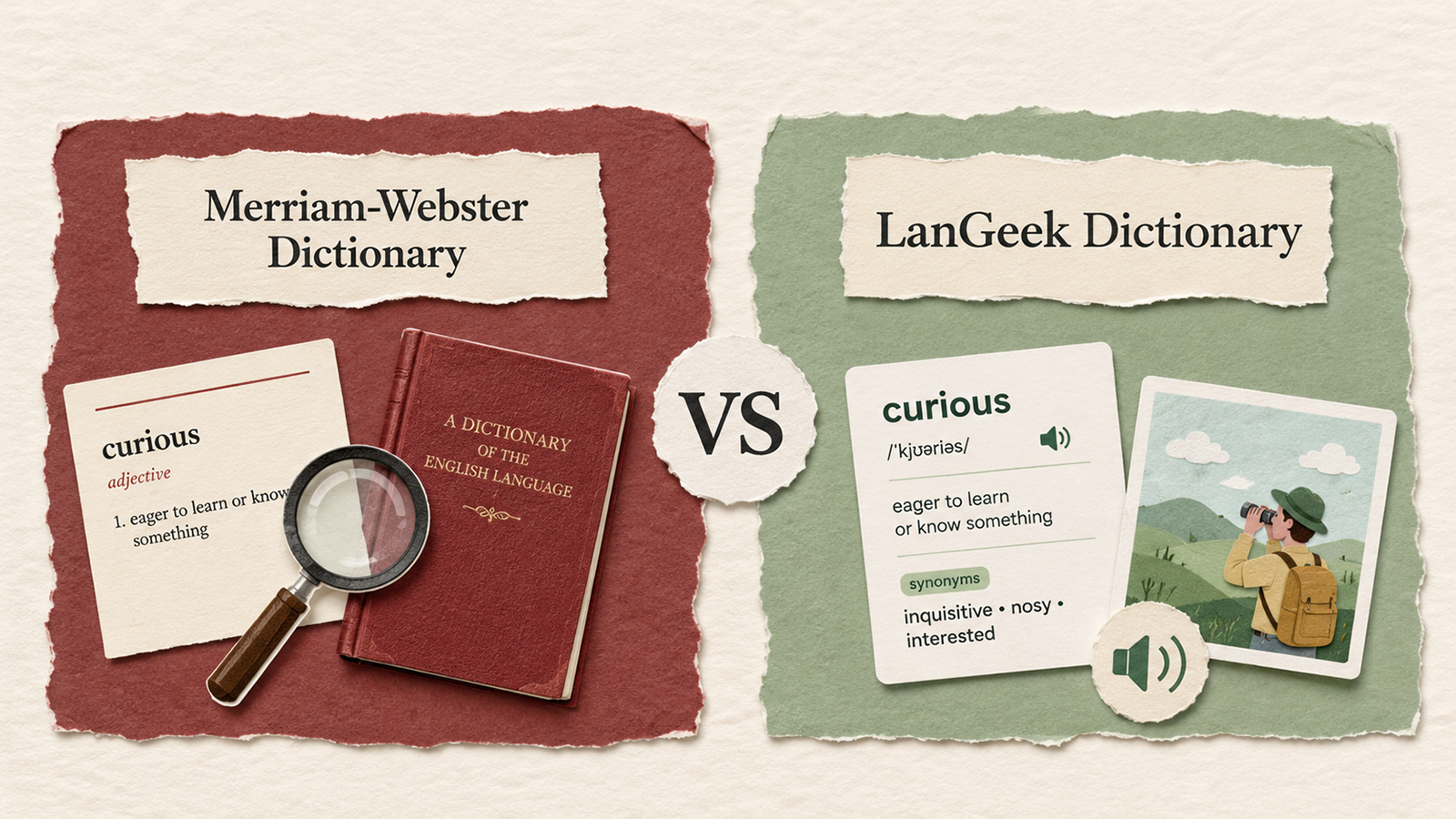
Merriam-Webster and LanGeek Dictionary both help users understand words, but they are built around different goals. Merriam-Webster is one of the best-known English dictionary brands, with strong definitions, thesaurus support, pronunciation, word games, Word of the Day, and language articles. LanGeek Dictionary is designed as a visual and learning-focused dictionary, connecting definitions with images, examples, translations, pronunciation tools, grammar information, Smart Lookup, Personal Wordlists, and Daily Words review.
This comparison looks at both dictionaries from the perspective of language learners and explains where each one is strongest.
A Quick Note About the Comparison
Merriam-Webster offers several dictionary products and language tools, including its main online dictionary, thesaurus, apps, learner resources, kids dictionary, medical dictionary, legal dictionary, Word of the Day, and word games. This article focuses mainly on Merriam-Webster as an English dictionary and vocabulary reference platform.
LanGeek Dictionary refers to LanGeek’s online Picture Dictionary, which supports English, German, French, and Spanish. It is part of the wider LanGeek learning platform and is designed specifically for language learners.
Overall Approach
| Area | Merriam-Webster | LanGeek Dictionary |
|---|---|---|
| Main Identity | English dictionary and reference platform | Visual dictionary and vocabulary-learning tool |
| Main Strength | Reliable English meanings, pronunciation, thesaurus, usage, and word culture | Visual learning, translations, pronunciation support, grammar details, and review tools |
| Best For | English reference, synonyms, word games, Word of the Day, spelling, usage, and advanced vocabulary discovery | Learning and remembering vocabulary through images, examples, pronunciation, translations, and active review |
| Learning Style | Reference-first | Learning-first |
| Main Language Focus | English | English, German, French, and Spanish |
Merriam-Webster is especially strong when users need an English reference dictionary. It is useful for checking definitions, spellings, pronunciations, synonyms, examples, and word histories. It also has a strong culture around English vocabulary through Word of the Day, quizzes, games, and language articles.
LanGeek Dictionary is more focused on the process of learning vocabulary. Instead of only giving a definition, it helps learners connect a word to a visual meaning, hear the pronunciation, read examples, check translations, understand grammar information, save the word, and review it later.
In simple terms, Merriam-Webster is excellent for looking up English words. LanGeek is especially useful for turning word lookup into vocabulary learning.
Core Strengths At a Glance
| Main Strengths of Merriam-Webster | Main Strengths of LanGeek Dictionary |
|---|---|
|
|
Feature-by-Feature Comparison
| Feature | Merriam-Webster | LanGeek Dictionary |
|---|---|---|
| Definitions | Strong English definitions | Learner-friendly definitions supported by images, examples, and translations |
| Visual Learning | Some illustration support in selected products | Visual learning is central to the dictionary experience |
| Example Sentences | Available and useful for context | Available and connected to learning tools |
| Pronunciation | Audio pronunciation and pronunciation guides | Audio pronunciation plus PhonoMap support |
| Thesaurus | Very strong standalone thesaurus support | Synonyms and related vocabulary support inside entries |
| Translations | Not the main focus of the core English dictionary | Built into the learner experience |
| Grammar Info | Usage and grammar guidance articles | Detailed word-level grammar information in entries |
| Word of the Day | Strong daily vocabulary discovery feature | Daily Words is more review and retention-focused |
| Saved Words | Favorites list and basic search history in apps | Personal Wordlists connected directly to study tools |
| Best Use Case | English reference and vocabulary discovery | Active vocabulary learning and retention |
Deep-Dive Analytical Breakdown
Definitions: Reference Depth vs. Learning Support
Merriam-Webster is strong as a reference dictionary. It gives users extensive definitions, phonetic keys, and usage rules. For native speakers and advanced scholars, this depth is unmatched. However, LanGeek Dictionary shapes definitions specifically around second-language learners. Instead of depending entirely on a textual definition, LanGeek surrounds a word with imagery, simple syntax, translations, and precise grammar traits. This multimodal layout lowers structural barriers for beginners and intermediate students who might struggle with complex text-only dictionary definitions.
Visual Learning: One of LanGeek’s Strongest Advantages
While Merriam-Webster stays primarily text-dense, the LanGeek Picture Dictionary prioritizes image association to strengthen memory neural links.
| Visual Learning Area | Merriam-Webster | LanGeek Dictionary |
|---|---|---|
| Role of Images | Supportive but rare | Central to the dictionary experience |
| Main Learner Benefit | Helps occasionally when illustrations are available | Helps learners connect words to meaning quickly |
| Best For | Reference and occasional visual support | Building vocabulary through visual memory |
| Beginner Usefulness | Useful, but remains text-heavy | Especially helpful for learners who need non-text support |
Pronunciation: Merriam-Webster Audio vs. LanGeek Audio and PhonoMap
Merriam-Webster supplies reliable studio audio for word entries. Yet, English spelling is rarely phonetic. To bridge this gap, LanGeek implements PhonoMap, which goes beyond audio playbacks to visually map spelling-to-sound relationships, stress points, and word syllables.
| Pronunciation Feature | Merriam-Webster | LanGeek Dictionary |
|---|---|---|
| Audio Quality | Strong native audio pronunciation support | Audio pronunciation integrated seamlessly into entries |
| Spelling-to-Sound Help | Not the main focus of the reference experience | Directly supported through visual PhonoMap systems |
| Syllables & Stress | Phonetic markers help check standard word sounds | Interactive maps make stress profiles obvious and scannable |
Examples and Context
While Merriam-Webster context blocks demonstrate clear native sentences, LanGeek overlays interactive components directly onto its context blocks. If you come across a secondary unfamiliar word inside a LanGeek example sentence, you can activate Smart Lookup to instantly inspect it without resetting your current search window or closing your tab.
Thesaurus and Related Words
Merriam-Webster holds a substantial advantage for editorial tasks, essayists, and native writers due to its comprehensive, highly structured historical thesaurus. LanGeek scales down deep synonym tiers to favor thematic word-family connections, keeping vocabulary expansion natural and manageable for language learners rather than overwhelming them with literary variants.
Grammar and Usage Information
Merriam-Webster details syntax history via long-form reference articles. LanGeek integrates structural data right into the vocabulary lookup card. Language learners can immediately see micro-data formatting points: transitivity states, plural irregularities, noun countability, and phrasal verb split properties.
Word Games, Daily Learning, and Review
Merriam-Webster drives gamified engagement using general trivia, spelling bees, and daily crossword updates. LanGeek channels daily activities strictly toward target language retention. Utilizing automated spaced-repetition schedules, its Daily Words panel guides users to review their curated folders systematically over time.
Which Dictionary Is Better for Different Users?
| Choose Merriam-Webster if you: | Choose LanGeek Dictionary if you: |
|---|---|
|
|
Merriam-Webster stands as an exceptional pillar for standard English lookup, native prose styling, and historical linguistic authority. It remains a reliable destination for advanced researchers, authors, and native speakers tracking down exact vocabulary nuances.
LanGeek Dictionary moves completely away from the passive reference model to form an integrated, active vocabulary-building ecosystem. By blending a Picture Dictionary with contextual tools like Smart Lookup, custom wordlists, translation support, and PhonoMap breakdowns, it transforms everyday searches into structured study habits. For language learners who want to move past simply viewing a word to truly internalizing it, LanGeek provides the optimal, scannable path toward language fluency.