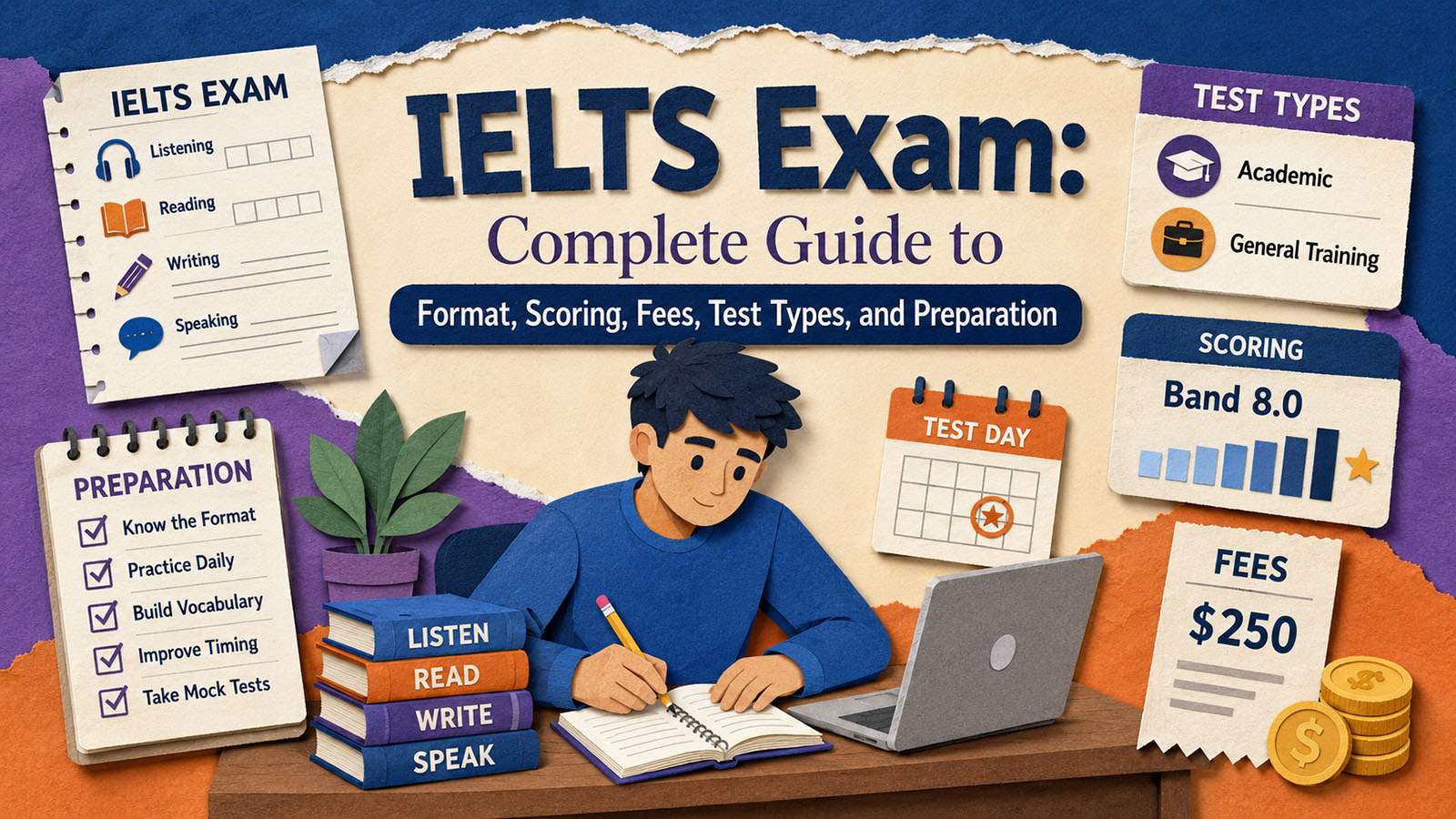
IELTS, short for the International English Language Testing System, is an English proficiency test used for university admission, professional registration, employment, and immigration.
The test assesses four language skills:
- Listeningv
- Reading
- Writing
- Speaking
IELTS is accepted by universities, employers, professional associations, and immigration authorities around the world. It is jointly owned by the British Council, IDP IELTS, and Cambridge University Press & Assessment.
There are several versions of IELTS, including IELTS Academic, IELTS General Training, IELTS for UK Visas and Immigration, and IELTS Life Skills. Choosing the correct version is essential because different institutions, professions, and immigration programs have different requirements.
This guide explains the IELTS test types, format, question types, scoring system, fees, registration process, result timelines, retake options, and preparation strategies.
IELTS Exam at a Glance
| Feature | IELTS |
|---|---|
| Full name | International English Language Testing System |
| Skills tested | Listening, Reading, Writing, and Speaking |
| Main test types | Academic and General Training |
| Total test time | Approximately 2 hours and 45 minutes |
| Band score range | 0 to 9 |
| Score increments | Whole and half bands |
| Delivery methods | Computer, paper, and IELTS Online in selected countries |
| Speaking format | Interview with a trained examiner |
| Computer test results | Usually available within 1 to 5 days |
| Paper test results | Usually available after 13 days |
| IELTS Online results | Usually available within 6 to 8 days |
| Recommended score validity | Two years |
| Retake options | Full retake or One Skill Retake where available |
| Test fee | Varies by country, test type, and test centre |
IELTS is available at more than 4,000 locations in approximately 140 countries. Candidates should always confirm that their chosen institution or immigration authority accepts the specific IELTS test and delivery method they intend to use.
What Is the IELTS Exam?
IELTS measures a candidate’s ability to communicate in English in academic, professional, and everyday situations.
Unlike tests that assess only grammar and vocabulary through multiple-choice questions, IELTS requires candidates to demonstrate practical language skills. They must understand spoken English, read different types of texts, produce extended writing, and communicate directly with an examiner.
The test does not have a universal pass or fail score. Each university, employer, professional body, or immigration authority decides what IELTS result it requires.
For example, one university may require an overall band score of 6.5 with no individual skill below 6.0. Another program may require 7.0 in Writing or Speaking. Immigration requirements may also specify minimum scores for every skill rather than only an overall score.
Candidates should therefore check both:
- The required overall band score
- The minimum score required in each individual skill
What Are the Different IELTS Test Types?
The main IELTS test types are:
- IELTS Academic
- IELTS General Training
- IELTS for UKVI
- IELTS Life Skills
Each test is intended for a different purpose.
IELTS Academic
IELTS Academic is intended mainly for people applying to:
- Undergraduate programs
- Postgraduate programs
- Universities and colleges
- Professional registration organizations
- Academic institutions
- Some skilled migration programs
The Reading and Writing sections use subjects and tasks related to academic study. However, candidates do not need specialist knowledge of a particular university subject.
IELTS Academic includes:
- Academic reading passages
- Graph, table, chart, map, process, or diagram descriptions
- Formal essay writing
- The standard IELTS Listening test
- The standard IELTS Speaking interview
The Listening and Speaking sections are the same in IELTS Academic and IELTS General Training. The Reading and Writing sections are different.
IELTS General Training
IELTS General Training is generally intended for people who want to:
- Migrate to an English-speaking country
- Apply for certain work or training programs
- Study below degree level
- Meet an immigration requirement
- Demonstrate practical English ability
Its Reading and Writing tasks focus more heavily on everyday, workplace, and social situations.
General Training Reading may include notices, advertisements, workplace documents, instructions, newspapers, magazines, and general-interest texts.
General Training Writing Task 1 requires candidates to write a letter instead of describing visual data.
Countries and programs commonly associated with IELTS General Training include immigration pathways for Australia, Canada, New Zealand, and the United Kingdom. However, candidates must check the exact requirements of the immigration program before booking.
IELTS for UKVI
IELTS for UKVI is a Secure English Language Test approved for certain United Kingdom visa and immigration applications.
The content, difficulty, scoring, and test format are generally the same as the corresponding standard IELTS Academic or General Training test. The main difference is that IELTS for UKVI is administered under additional security and identity-verification requirements at an approved UKVI test centre.
Candidates should choose IELTS for UKVI only when their visa category or receiving organization specifically requires it.
UK visa requirements differ according to the visa route. Some routes require proof of Listening and Speaking only, while others require minimum scores in all four skills. Candidates should verify the current requirement directly with the UK government before registering.
IELTS Life Skills
IELTS Life Skills is intended for certain UK visa and immigration applications that require candidates to demonstrate only Speaking and Listening ability.
It is available at three levels:
| Test | CEFR level | Skills tested |
| IELTS Life Skills A1 | A1 | Speaking and Listening |
| IELTS Life Skills A2 | A2 | Speaking and Listening |
| IELTS Life Skills B1 | B1 | Speaking and Listening |
IELTS Life Skills does not produce a band score from 0 to 9. Candidates receive either:
- Pass
- Fail
The required Life Skills level depends on the visa or immigration route. For example, different levels may apply to an initial family visa, an extension, settlement, or citizenship.
IELTS Academic vs General Training
The Listening and Speaking sections are the same in both tests. The main differences are in Reading and Writing.
| Feature | IELTS Academic | IELTS General Training |
| Main purpose | University study and professional registration | Migration, employment, training, and below-degree study |
| Listening | Same test | Same test |
| Speaking | Same test | Same test |
| Reading | Academic-style texts | Everyday, workplace, and general-interest texts |
| Writing Task 1 | Describe visual information | Write a letter |
| Writing Task 2 | Essay | Essay |
| Scoring scale | 0 to 9 | 0 to 9 |
| Difficulty | Reading texts are generally more academically complex | A higher number of correct Reading answers may be needed for the same band |
Neither version is universally easier. Candidates often find the version that matches their experience and goals more familiar.
General Training Reading uses more practical texts, but candidates normally need more correct answers to receive the same Reading band score. Academic Writing Task 1 may be unfamiliar to candidates who have not practised describing charts, processes, maps, and diagrams.
How Long Is the IELTS Exam?
The four IELTS sections take approximately 2 hours and 45 minutes in total.
| Section | Approximate time |
| Listening | 30 minutes |
| Reading | 60 minutes |
| Writing | 60 minutes |
| Speaking | 11 to 14 minutes |
Listening, Reading, and Writing are normally completed in one session without a break. This session takes approximately 2 hours and 40 minutes.
The Speaking test may be held on the same day or on a different day, depending on the test centre and local schedule. Candidates should check the details provided with their booking.
The exact Listening procedure differs slightly between paper and computer delivery because paper test takers receive additional time to transfer their answers.
IELTS Listening Test
The IELTS Listening section is the same for Academic and General Training candidates.
It contains:
- Four parts
- Ten questions in each part
- Forty questions in total
- Approximately 30 minutes of listening
Candidates hear each recording only once. Questions follow the order of information in the recording.
IELTS Listening Parts
The recordings gradually move from everyday situations to educational and academic contexts.
Part 1
A conversation between two people in an everyday social situation.
Examples include:
- Booking accommodation
- Registering for a service
- Asking about a course
- Arranging an event
Part 2
A monologue in an everyday social context.
Examples include:
- A tour guide describing a location
- Information about public facilities
- Instructions for an event
- A talk about local services
Part 3
A conversation involving up to four people in an educational or training context.
Examples include:
- Students discussing an assignment
- A student speaking with a tutor
- A group planning a research project
Part 4
A monologue on an academic subject.
This is commonly presented as a lecture or educational talk.
IELTS Listening Question Types
Common question types include:
- Multiple choice
- Matching
- Form completion
- Note completion
- Table completion
- Flow-chart completion
- Summary completion
- Sentence completion
- Map or diagram labelling
- Short-answer questions
Spelling is important. An answer can be marked incorrect when it contains a spelling mistake or does not follow the stated word limit.
Candidates should pay attention to instructions such as:
- Write one word only
- Write no more than two words
- Write one word and/or a number
IELTS Reading Test
The IELTS Reading section lasts 60 minutes and contains 40 questions.
There is no additional answer-transfer time for Reading. Candidates taking the paper test must transfer their answers within the 60-minute limit.
IELTS Academic Reading
Academic Reading contains three long reading passages.
The texts may come from:
- Books
- Journals
- Magazines
- Newspapers
- Academic publications
- General-interest educational sources
The passages are written for a non-specialist audience, so candidates are not expected to have expert knowledge of the subject.
At least one passage may contain a detailed logical argument.
IELTS General Training Reading
General Training Reading is divided into three sections.
Section 1
Short texts related to everyday life, such as:
- Advertisements
- Timetables
- Notices
- Public information
- Instructions
Section 2
Texts related to work, such as:
- Job descriptions
- Staff training materials
- Workplace policies
- Contracts
- Company handbooks
Section 3
A longer text on a general-interest topic.
IELTS Reading Question Types
Common Reading question types include:
- Multiple choice
- Matching headings
- Matching information
- Matching features
- Matching sentence endings
- True, False, Not Given
- Yes, No, Not Given
- Sentence completion
- Summary completion
- Note completion
- Table completion
- Flow-chart completion
- Diagram labelling
- Short-answer questions
Candidates must distinguish carefully between:
- False: The passage contradicts the statement.
- Not Given: The passage does not provide enough information.
- No: The statement contradicts the writer’s views or claims.
- Not Given: The writer’s view is not stated clearly enough.
IELTS Writing Test
The Writing test lasts 60 minutes and contains two tasks.
Candidates are advised to spend approximately:
- 20 minutes on Task 1
- 40 minutes on Task 2
Task 2 contributes more to the final Writing band score than Task 1.
IELTS Academic Writing
Academic Writing Task 1
Candidates must describe visual information using at least 150 words.
The task may include:
- A line graph
- A bar chart
- A pie chart
- A table
- A map
- A process
- A diagram
- A combination of visual sources
Candidates should identify and summarize the most important features, compare relevant information, and present a clear overview.
They should not add personal opinions or explanations that are not supported by the visual information.
Academic Writing Task 2
Candidates must write an essay of at least 250 words.
The task may ask them to:
- Discuss two views
- Give an opinion
- Explain advantages and disadvantages
- Identify causes and solutions
- Respond to a problem
- Evaluate an argument
- Answer two related questions
Academic Writing Task 1 requires at least 150 words, while Task 2 requires at least 250 words. Both tasks must be completed within 60 minutes.
IELTS General Training Writing
General Training Writing Task 1
Candidates must write a letter of at least 150 words in response to a situation.
The letter may be:
- Formal
- Semi-formal
- Informal or personal
The prompt normally includes three points that must be addressed.
Candidates may need to:
- Request information
- Explain a problem
- Make a complaint
- Invite someone
- Apologize
- Describe a situation
- Suggest a solution
The style, greeting, vocabulary, and closing should match the relationship between the writer and recipient.
General Training Writing Task 2
Candidates must write an essay of at least 250 words.
The topics are usually of general interest and may be less academically framed than those in IELTS Academic. However, the candidate must still develop a clear position, organize ideas logically, and support arguments with relevant explanations and examples.
How IELTS Writing Is Scored
Writing is assessed using four criteria:
- Task Achievement for Task 1 or Task Response for Task 2
- Coherence and Cohesion
- Lexical Resource
- Grammatical Range and Accuracy
Task Achievement and Task Response
This criterion assesses whether the candidate:
- Answers all parts of the question
- Presents a clear position
- Includes relevant information
- Develops ideas sufficiently
- Supports claims with explanations or examples
Coherence and Cohesion
This measures how clearly ideas are organized and connected.
Examiners consider:
- Paragraphing
- Logical progression
- Referencing
- Linking words
- Overall organization
Using too many linking expressions mechanically can reduce clarity rather than improve it.
Lexical Resource
This assesses:
- Vocabulary range
- Word choice
- Accuracy
- Collocations
- Spelling
- Ability to paraphrase
Candidates do not need to use rare words. Accurate and appropriate vocabulary is more important than unnecessarily complicated vocabulary.
Grammatical Range and Accuracy
This criterion assesses:
- Sentence variety
- Grammatical accuracy
- Punctuation
- Control of complex structures
- Frequency and effect of errors
The four criteria are equally weighted within each task, but Writing Task 2 contributes more heavily to the final Writing score.
IELTS Speaking Test
The Speaking test takes between 11 and 14 minutes.
It is conducted as an interview with a trained IELTS examiner and is recorded. The Speaking test is the same for Academic and General Training candidates.
The test contains three parts.
IELTS Speaking Part 1
Part 1 lasts approximately four to five minutes.
The examiner checks the candidate’s identity and asks questions about familiar subjects, such as:
- Home
- Family
- Work
- Education
- Hobbies
- Daily routines
- Transport
- Food
- Technology
Candidates should answer naturally and provide enough detail to demonstrate their ability. Answers consisting of only one or two words usually do not provide sufficient evidence of speaking ability.
IELTS Speaking Part 2
In Part 2, the candidate receives a task card with a topic and several prompts.
The candidate receives:
- One minute to prepare
- Paper and a pencil for notes
- Up to two minutes to speak
The examiner may ask one or two short questions after the candidate finishes.
The entire part takes approximately three to four minutes, including preparation time.
IELTS Speaking Part 3
Part 3 lasts approximately four to five minutes.
The examiner asks more abstract questions connected to the topic in Part 2.
Candidates may need to:
- Explain opinions
- Compare past and present situations
- Discuss causes and effects
- Suggest solutions
- Make predictions
- Analyze social issues
- Consider advantages and disadvantages
The questions are generally broader and more analytical than those in Part 1.
How IELTS Speaking Is Scored
Speaking is assessed using four equally weighted criteria:
- Fluency and Coherence
- Lexical Resource
- Grammatical Range and Accuracy
- Pronunciation
Fluency and Coherence
This assesses whether the candidate can:
- Speak continuously
- Organize ideas logically
- Develop answers
- Use linking expressions naturally
- Avoid excessive hesitation and repetition
Lexical Resource
This measures:
- Range of vocabulary
- Accuracy of word choice
- Ability to paraphrase
- Appropriate use of idiomatic language
- Ability to discuss familiar and unfamiliar subjects
Grammatical Range and Accuracy
Candidates are assessed on:
- Variety of sentence structures
- Control of verb forms
- Sentence accuracy
- Ability to use complex grammar
- Whether errors interfere with communication
Pronunciation
Pronunciation is assessed according to how easily the examiner can understand the candidate.
Candidates do not need a British, American, Australian, or other native-speaker accent. They need to communicate clearly using understandable sounds, word stress, sentence stress, rhythm, and intonation.
How Is IELTS Scored?
IELTS uses a band scale from 0 to 9.
Candidates receive five scores:
- Listening band score
- Reading band score
- Writing band score
- Speaking band score
- Overall band score
Scores are reported in whole and half bands, such as:
- 5.0
- 5.5
- 6.0
- 6.5
- 7.0
- 7.5
IELTS Band Score Meanings
| Band | General description |
| 9 | Expert user |
| 8 | Very good user |
| 7 | Good user |
| 6 | Competent user |
| 5 | Modest user |
| 4 | Limited user |
| 3 | Extremely limited user |
| 2 | Intermittent user |
| 1 | Non-user |
| 0 | Did not attempt the test |
A band 7 candidate generally has an effective command of English, although occasional inaccuracies and misunderstandings may occur. A band 6 candidate has an effective but less consistent command and can generally use reasonably complex English in familiar situations.
How Is the Overall IELTS Band Calculated?
The overall band score is the average of the four skill scores.
For example:
| Skill | Score |
| Listening | 7.5 |
| Reading | 7.0 |
| Writing | 6.0 |
| Speaking | 6.5 |
| Average | 6.75 |
| Overall band | 7.0 |
IELTS rounds the average to the nearest whole or half band.
- An average ending in .25 is rounded up to the next half band.
- An average ending in .75 is rounded up to the next whole band.
- Other averages are rounded to the nearest whole or half band.
For example:
| Average | Reported overall band |
| 6.125 | 6.0 |
| 6.25 | 6.5 |
| 6.5 | 6.5 |
| 6.75 | 7.0 |
| 6.875 | 7.0 |
The overall score does not replace individual skill requirements. A candidate may receive an overall 7.0 but still fail to meet a requirement of 6.5 in every skill.
IELTS Listening and Reading Raw Scores
Listening and Reading each contain 40 questions. Every correct answer receives one raw mark.
The raw score is then converted into a band score.
Approximate Listening conversions include:
| Correct answers out of 40 | Approximate band |
| 16 | 5 |
| 23 | 6 |
| 30 | 7 |
| 35 | 8 |
Approximate Academic Reading conversions include:
| Correct answers out of 40 | Approximate band |
| 15 | 5 |
| 23 | 6 |
| 30 | 7 |
| 35 | 8 |
Approximate General Training Reading conversions include:
| Correct answers out of 40 | Approximate band |
| 15 | 4 |
| 23 | 5 |
| 30 | 6 |
| 35 | 7 |
The exact conversion can vary slightly between test versions to account for differences in difficulty.
What Is a Good IELTS Score?
A good IELTS score is one that meets the exact requirements of the candidate’s chosen institution or immigration program.
General reference points include:
| Overall band | General interpretation |
| 5.0 | Modest English ability |
| 5.5 | Often accepted for some foundation or pathway programs |
| 6.0 | Common minimum for some undergraduate or training programs |
| 6.5 | Common university admission requirement |
| 7.0 | Common for competitive academic and professional programs |
| 7.5 or higher | Strong result for demanding academic or professional purposes |
These are general examples, not universal requirements.
Some programs place particular importance on one skill. Nursing, teaching, law, and healthcare programs may require higher Speaking or Writing scores. Immigration systems may award different numbers of points according to individual skill scores.
IELTS and CEFR Levels
IELTS scores can be compared approximately with the Common European Framework of Reference for Languages.
| IELTS band | Approximate CEFR level |
| 4.0 to 5.0 | B1 |
| 5.5 to 6.5 | B2 |
| 7.0 to 8.0 | C1 |
| 8.5 to 9.0 | C2 |
The comparison is approximate because IELTS and the CEFR were developed for different purposes. Institutions should use their own published entry requirements rather than relying only on a conversion table. IELTS identifies scores of 5.5 to 6.5 broadly with B2 and scores of 7 to 8 broadly with C1.
IELTS on Computer vs IELTS on Paper
IELTS Academic and General Training may be available on computer or paper, depending on the test centre.
The test content, question types, assessment criteria, and band scoring are the same.
| Feature | IELTS on computer | IELTS on paper |
| Listening answers | Entered on screen | Written on an answer sheet |
| Reading answers | Entered on screen | Written on an answer sheet |
| Writing | Typed | Handwritten |
| Speaking | With an examiner | With an examiner |
| Result time | Usually 1 to 5 days | Usually 13 days |
| Editing Writing | Easier to edit typed text | Requires manual corrections |
| Availability | Depends on location | Depends on location |
Candidates who type quickly may prefer the computer test. Candidates who are more comfortable handwriting essays or making notes on paper may prefer the paper test.
The computer version includes functions such as highlighting, copying and pasting within the test interface, adjusting text size, and reviewing unanswered questions.
The Speaking section remains an interview with a trained examiner.
IELTS on Computer With Writing on Paper
In selected locations, candidates may take Listening and Reading on computer but complete the Writing section by hand.
The Writing tasks appear on the screen, while answers are written on an official answer sheet.
Availability depends on the country and test centre. Results are generally provided within five days, and the Test Report Form does not state that the candidate selected the Writing on Paper option.
IELTS Online
IELTS Online allows eligible candidates in selected countries to take IELTS Academic from home or another suitable private location.
It is currently available only for IELTS Academic, not General Training.
IELTS Online has the same general:
- Test format
- Timings
- Question types
- Marking criteria
- Band-score system
The Speaking section is completed by video call with a trained examiner.
Candidates must check whether their receiving institution accepts IELTS Online before booking. The Test Report Form indicates that the test was completed online, and institutions can decide whether to accept it.
IELTS Online is not intended for immigration purposes. Results are generally available within six to eight days.
How Much Does the IELTS Exam Cost?
There is no single worldwide IELTS fee.
The cost depends on:
- Country
- City
- Test centre
- Test type
- Local taxes
- Delivery method
- Currency
- Whether the test is IELTS for UKVI or Life Skills
IELTS Academic and General Training often have the same fee within a country, but this is not guaranteed. IELTS for UKVI and IELTS Life Skills may have different prices.
Candidates should use the official IELTS test-centre search and select their country, city, and test type to view the exact current price.
Additional charges may apply for:
- Changing the test date
- Cancelling the test
- Requesting a score review
- Sending additional Test Report Forms
- IELTS One Skill Retake
- Special administrative services
Fees and refund rules can vary by local test provider.
How to Register for IELTS
The usual registration process is:
- Identify the test required by the university, employer, professional body, or immigration authority.
- Choose Academic, General Training, UKVI, or Life Skills.
- Select computer, paper, or online delivery where available.
- Find an official IELTS test centre.
- Choose an available date.
- Create an account or complete the test-centre application.
- Enter personal information exactly as shown on the identification document.
- Upload or submit the required identification.
- Pay the test fee.
- Review the booking confirmation and test-day instructions.
Candidates must use an accepted identification document. They should bring the same document on test day that they used during registration.
A candidate who brings the wrong ID or forgets the required document may not be allowed to take the test.
What to Bring on IELTS Test Day
Candidates should bring:
- The same approved identification document used for registration
- Their test confirmation details, when requested
- Water in a transparent bottle, if permitted
- Any approved access-arrangement documents
Personal items are normally stored outside the test room.
Restricted items commonly include:
- Mobile phones
- Smartwatches
- Watches
- Electronic devices
- Notes
- Dictionaries
- Study materials
- Unauthorized stationery
Test rooms normally have a visible clock. Candidates should arrive early enough to complete identity checks and registration procedures.
Listening, Reading, and Writing are taken in one session without a scheduled break. Candidates should eat, drink, and use the bathroom before entering the test room.
When Are IELTS Results Released?
Result timelines depend on the delivery method.
| IELTS format | Typical result time |
| IELTS on computer | 1 to 5 days |
| IELTS on paper | 13 days |
| IELTS Online | 6 to 8 days |
| One Skill Retake | 3 to 5 days |
Candidates receive a Test Report Form as official evidence of their result. It may be provided as a paper document or an electronic Test Report Form.
Receiving organizations can verify the result through the IELTS Results Service.
How Long Are IELTS Scores Valid?
IELTS recommends that results be considered valid for two years from the test date.
The two-year recommendation is based on the possibility that language ability may decline when it is not actively used.
An institution may choose to accept an older result, particularly when the candidate can provide evidence that they have maintained or improved their English. Candidates should check the specific policy of the university, employer, professional association, or immigration authority.
Can You Retake IELTS?
There is no general IELTS limit on how many times a candidate can take the full test.
Candidates can register again whenever they are ready and when a test date is available. There is normally no mandatory waiting period between full IELTS attempts.
However, repeatedly taking the test without changing the preparation method may not improve the result. Candidates should review their score report, identify the weakest skill, and complete targeted preparation before retaking the exam.
What Is IELTS One Skill Retake?
IELTS One Skill Retake allows eligible candidates to retake one section instead of repeating the entire test.
A candidate may choose to retake:
- Listening
- Reading
- Writing
- Speaking
To qualify, the candidate must generally:
- Have completed a full IELTS on computer test
- Have taken the full test at a centre offering One Skill Retake
- Complete the retake within 60 days of the original test
- Use the option only once for that original test
One Skill Retake is available for Academic and General Training at participating centres.
After the retake, the candidate receives a new Test Report Form containing the new score for the retaken skill and the original scores for the other three skills. The original Test Report Form remains available.
Not every university, professional organization, or immigration authority accepts One Skill Retake. Candidates should confirm acceptance before paying for it. Results are normally available within three to five days.
Can You Request an IELTS Re-mark?
Candidates who believe that their result does not accurately reflect their performance may request an Enquiry on Results.
This process involves having one or more test sections reviewed by senior examiners.
Candidates may request a review of:
- Listening
- Reading
- Writing
- Speaking
- Any combination of the four skills
A fee usually applies. It is generally refunded when the review changes the candidate’s score.
Fees, deadlines, and processing times depend on the test centre and local provider. Candidates should request the review within the permitted period and should not assume that a score will increase.
IELTS Access Arrangements
IELTS test centres may provide approved arrangements for candidates with disabilities, medical conditions, or specific learning difficulties.
Possible arrangements can include:
- Extra time
- Supervised breaks
- Enlarged test materials
- Braille papers
- Modified Listening materials
- A separate test room
- A reader
- A scribe
- Assistive technology
Some arrangements can take up to six weeks to organize. Candidates should contact the test centre before booking or as early as possible and provide any required supporting documentation.
How to Prepare for IELTS
Effective IELTS preparation requires both English development and familiarity with the test.
A candidate may have strong general English but lose marks because of weak timing, incomplete answers, unfamiliar question types, or misunderstanding of the scoring criteria.
1. Identify the Required Score
Before studying, candidates should determine:
- Which IELTS test they need
- The required overall band
- The minimum score for each skill
- The application deadline
- Whether One Skill Retake is accepted
- Whether computer, paper, or online results are accepted
This prevents candidates from preparing for or booking the wrong test.
2. Take a Diagnostic Test
A full diagnostic practice test can identify:
- Current approximate band level
- Strongest skill
- Weakest skill
- Timing difficulties
- Vocabulary gaps
- Grammar problems
- Unfamiliar question types
The diagnostic should be completed under realistic time limits.
3. Create a Study Plan
A balanced eight-week IELTS study plan might look like this:
| Week | Main focus |
| 1 | Diagnostic test and score analysis |
| 2 | Listening question types and vocabulary |
| 3 | Reading strategies and time management |
| 4 | Writing Task 1 structure |
| 5 | Writing Task 2 development and grammar |
| 6 | Speaking fluency and pronunciation |
| 7 | Timed section practice |
| 8 | Full mock tests and final review |
Candidates with a large gap between their current level and target score may need several months of general English development before intensive exam practice.
4. Use Official IELTS Materials
Official preparation resources help candidates become familiar with:
- Realistic task instructions
- Current question formats
- Timing
- Answer-sheet procedures
- Writing assessment criteria
- Speaking assessment criteria
Candidates should be cautious with unofficial materials that promise exact future questions or guaranteed band scores.
5. Keep an Error Log
After every practice session, candidates should record:
- The question type
- The incorrect answer
- The correct answer
- The reason for the mistake
- The rule or strategy needed
- Whether the problem involved vocabulary, grammar, timing, or attention
An error log helps candidates identify repeated patterns instead of treating every mistake as unrelated.
IELTS Listening Preparation Tips
- Read the questions before the recording begins.
- Predict whether the answer will be a name, number, date, noun, adjective, or location.
- Follow the stated word limit.
- Expect corrections and changes of mind in conversations.
- Practise recognizing different English accents.
- Check spelling and plural forms.
- Do not stop listening after missing one answer.
- Use the order of questions to follow the recording.
- Transfer answers carefully when taking the paper test.
IELTS Reading Preparation Tips
- Practise locating information quickly.
- Read the questions before studying a passage in detail.
- Learn the difference between False and Not Given.
- Identify synonyms and paraphrases.
- Do not spend too long on one question.
- Follow the required word limit.
- Check whether an answer should be singular or plural.
- Practise all three passages within 60 minutes.
- Avoid relying on outside knowledge.
- Base every answer only on the text.
IELTS Writing Preparation Tips
- Analyze every part of the prompt before writing.
- Plan the response briefly.
- Use clear paragraphs.
- Present a clear overview in Academic Task 1.
- Address all three bullet points in General Training Task 1.
- State and develop a clear position in Task 2.
- Support main ideas with explanations and examples.
- Leave time to check grammar and spelling.
- Avoid memorized essays that do not answer the exact question.
- Practise producing at least 150 and 250 words within the time limits.
- Give more time to Task 2 because it carries greater weight.
IELTS Speaking Preparation Tips
- Answer naturally rather than memorizing scripts.
- Extend answers with reasons and examples.
- Record practice sessions.
- Listen for repeated hesitation.
- Practise speaking for two minutes without stopping.
- Use the one-minute Part 2 preparation period to organize ideas.
- Develop answers more fully in Part 3.
- Practise paraphrasing unknown vocabulary.
- Focus on being understandable rather than imitating a particular accent.
- Correct occasional mistakes naturally without restarting the entire answer.
Common IELTS Preparation Mistakes
Choosing the Wrong Test
IELTS Academic and General Training are not interchangeable for every purpose. Candidates should confirm the correct test before booking.
Focusing Only on the Overall Score
Many organizations require minimum scores in individual skills. A high Listening score may raise the overall average but cannot compensate for a Writing score below the stated minimum.
Ignoring Task Instructions
Writing fewer than the required number of words, exceeding a Listening word limit, or failing to address part of a Writing prompt can reduce the score.
Memorizing Answers
Memorized Speaking and Writing responses may not fit the question and can sound unnatural. Examiners assess whether the candidate responds appropriately to the task.
Taking Too Many Practice Tests
Practice tests reveal problems but do not automatically solve them. Candidates also need targeted work on grammar, vocabulary, pronunciation, reading speed, and essay development.
Using Complicated Vocabulary Incorrectly
Accurate and natural vocabulary is more effective than rare words used incorrectly.
Neglecting Time Management
Candidates should practise every section under official time limits. Reading and Writing are particularly difficult to complete without a clear time-management strategy.
Frequently Asked Questions About IELTS
Is IELTS difficult?
IELTS can be challenging because it measures four different language skills under strict time limits. Its difficulty depends on the candidate’s current English level, target score, familiarity with the test, and preparation.
Is IELTS Academic harder than General Training?
The tests are designed for different purposes. Academic Reading uses more academically complex texts, while General Training candidates often need more correct Reading answers to achieve the same band. Academic Writing Task 1 and General Training letter writing require different skills.
Is IELTS accepted in the United States?
Many universities, colleges, employers, and professional organizations in the United States accept IELTS. Candidates should confirm the requirements of each institution.
Is IELTS accepted for Canadian immigration?
IELTS General Training is accepted for various Canadian immigration programs. The required scores depend on the program and immigration category. Applicants should check the current official Canadian government requirements.
Can I take IELTS from home?
IELTS Online is available for Academic candidates in selected countries. It is not universally available or accepted, and it is not intended for immigration. Candidates should check with their receiving institution before booking.
Is IELTS on computer easier?
The content and scoring are the same. The best option depends on whether the candidate is more comfortable typing or handwriting, reading from a screen or paper, and using digital test tools.
Can I use a dictionary in IELTS?
No. Dictionaries and translation tools are not permitted during the test.
Is there a break during IELTS?
Listening, Reading, and Writing are normally completed in one session without a scheduled break. The Speaking test is conducted separately or at another scheduled time.
How many times can I take IELTS?
There is no general limit on the number of full IELTS attempts. Candidates can register again when a test date is available.
Can I retake only IELTS Writing?
Eligible candidates may retake only Writing through IELTS One Skill Retake when the original test was IELTS on computer at a participating centre. The retake must normally be completed within 60 days.
Does IELTS have negative marking?
No. Candidates do not lose additional marks for incorrect Listening or Reading answers. They should attempt every question.
Are spelling mistakes penalized?
Yes. Spelling mistakes can cause Listening and Reading answers to be marked incorrect. Spelling also affects the Writing score.
Can I use American spelling?
IELTS accepts standard forms of British, American, Australian, and other recognized English varieties. Candidates should use spelling consistently.
Do I need a British accent for IELTS Speaking?
No. Candidates are assessed on whether their pronunciation is clear and understandable, not whether they sound British.
How long should I prepare for IELTS?
Preparation time depends on the candidate’s starting level and target score. Candidates close to their target may need several weeks of focused test preparation. Candidates who need a substantial improvement may require several months of general English study.
How soon can I receive my IELTS result?
Computer test results are normally available within one to five days. Paper results are generally available after 13 days. IELTS Online results normally take six to eight days.
How long is an IELTS result valid?
IELTS recommends a validity period of two years, although individual organizations may choose to accept older results.
What should I do if my score is lower than expected?
Candidates may:
- Request an Enquiry on Results
- Take the entire test again
- Use One Skill Retake when eligible
- Review their preparation strategy
- Confirm whether the receiving organization accepts a combination of results
References
- IELTS: Test Types
- IELTS: Academic Test Format and Sections
- IELTS: General Training Test Format and Sections
- IELTS: Tests for UK Visas and Immigration
- IELTS: IELTS for UKVI Life Skills
- IELTS: Listening Test Format
- IELTS: Academic Reading Test Format
- IELTS: Academic Writing Test Format
- IELTS: General Training Writing Test Format
- IELTS: Speaking Test Format
- IELTS: Band Scores and Scoring Explained
- IELTS: Ways to Take IELTS
- IELTS: Booking Your Test
- IELTS: Find a Test Centre and Current Fees
- IELTS: One Skill Retake
- IELTS: Getting and Sharing Your Results
- IELTS: Result Verification and Validity
- IELTS: What to Expect on Test Day
- IELTS: Access Arrangements and Test Support
- IELTS: Official Sample Test Questions