Learning English vocabulary is one of the most important parts of becoming fluent in English. Grammar helps you build correct sentences, pronunciation helps you speak clearly, and listening practice helps you understand others, but vocabulary gives you the words you need to communicate your ideas.
Many learners try to memorize long lists of English words, but after a few days, they forget most of them. This usually happens because vocabulary learning is not only about memorizing definitions. To truly learn a word, you need to know its meaning, pronunciation, spelling, grammar, common combinations, and real-life usage.
In this article, we will look at practical tips to help you learn English vocabulary more effectively. We will also show how tools like LanGeek’s picture dictionary, vocabulary lists, flashcards, quizzes, and word review features can make the learning process easier and more organized.
Why Is Vocabulary Important in English Learning?
Vocabulary is the foundation of communication. The more words you know, the easier it becomes to understand English and express yourself clearly.
A strong vocabulary helps you:
- understand conversations, movies, podcasts, and videos;
- read books, articles, websites, and social media posts more easily;
- speak with more confidence;
- write better essays, emails, and messages;
- understand grammar examples more clearly;
- prepare for exams such as IELTS, TOEFL, or school tests.
However, vocabulary learning should be active and organized. You should not only ask, “What does this word mean?” You should also ask, “How is this word used?”
1. Learn Words in Context
One of the most common mistakes English learners make is studying words alone. A single English word can have different meanings depending on the sentence.
For example, look at the word run:
| Sentence | Meaning of “Run” |
|---|---|
| The boy runs fast. | To move quickly on foot |
| She runs a company. | To manage or operate |
| The machine runs on electricity. | To function or work |
| His nose is running. | To produce liquid |
If you only memorize one translation of run, you may not understand it in different situations. That is why context is important.
Instead of learning only:
avoid = to stay away from something
Learn it with a full sentence:
You should avoid eating too much sugar.
This sentence shows the meaning of the word and also teaches you how to use it. For example, avoid is often followed by a noun or a gerund:
- avoid mistakes
- avoid problems
- avoid eating too much
- avoid making noise

How LanGeek Can Help
LanGeek provides vocabulary examples and definitions that help you understand how words are used in real contexts. Instead of memorizing a word as an isolated item, you can study its meaning, example sentences, and related information in one place.
2. Use Pictures to Remember Words Faster
Many learners remember words better when they see an image. This is especially useful for concrete nouns, such as:
- apple
- mountain
- bridge
- kitchen
- helmet
- elephant
When you connect an English word to a picture, your brain can remember it more easily. You do not need to translate the word into your native language every time. Instead, you connect the English word directly to the object or idea.
For example, if you see a picture of a ladder, you can understand the meaning immediately. This makes the word easier to remember and faster to recognize later.
Pictures can also help with some abstract words:
| Word | Possible Visual Idea |
|---|---|
| confidence | A person speaking in front of an audience |
| decision | A person choosing between two paths |
| freedom | A bird flying in the sky |
| teamwork | A group of people working together |
| success | A person reaching a goal |
Use LanGeek’s Picture Dictionary
LanGeek’s online picture dictionary is especially useful for visual learners. It helps learners connect English words with images, which makes vocabulary learning more natural and memorable. This is helpful for beginners, young learners, and anyone who prefers learning through visual examples.
3. Learn Word Families
A word family includes different forms of the same base word. Learning word families is a smart way to expand your vocabulary because one word can help you learn several related words.
For example:
| Base Word | Related Words |
|---|---|
| create | creation, creative, creatively, creator, creativity |
| decide | decision, decisive, indecisive, decidedly |
| educate | education, educator, educational, educated |
| improve | improvement, improved, improving |
| act | action, active, activity, actor, reaction |
Learning word families helps you understand how English words are formed. It also helps you use the correct form of a word in different sentences.
Compare these examples:
- She decided to study abroad.
- It was a difficult decision.
- He is a very decisive leader.
All three words are related, but they have different grammatical roles.
Practical Tip
When you learn a new word, ask yourself:
- Is it a noun, verb, adjective, or adverb?
- Does it have other forms?
- Can I use the related words in sentences?
- Are there prefixes or suffixes connected to this word?
This method is especially useful for intermediate and advanced learners who want to improve their reading and writing skills.
4. Learn Collocations, Not Just Single Words
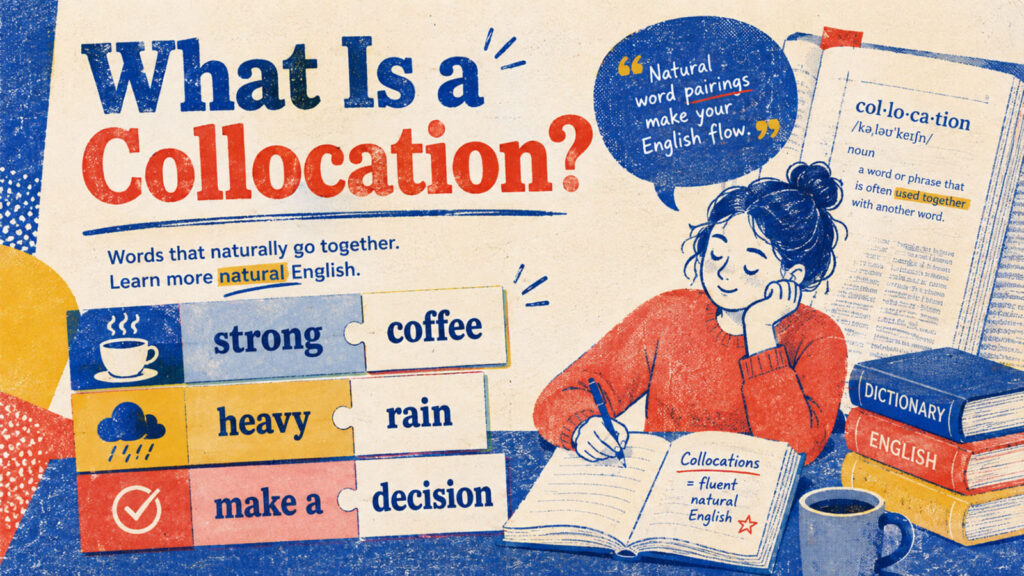
A collocation is a natural combination of words. Native speakers often use certain words together. Learning these combinations helps your English sound more natural.
For example, English speakers usually say:
- make a mistake
- do homework
- take a shower
- have breakfast
- heavy rain
- strong coffee
- deep sleep
Some learners may say “do a mistake” because they translate directly from their own language. However, the natural English phrase is “make a mistake.”
Common English Collocations
| Word | Common Collocations |
|---|---|
| decision | make a decision, final decision, difficult decision |
| mistake | make a mistake, serious mistake, common mistake |
| goal | achieve a goal, set a goal, reach a goal |
| problem | solve a problem, serious problem, common problem |
| advice | give advice, ask for advice, useful advice |
Instead of learning only the word decision, learn useful phrases with it:
- make a decision
- a difficult decision
- a final decision
- an important decision
- a quick decision
This helps you use the word more naturally in speaking and writing.
How LanGeek Can Help
LanGeek includes vocabulary categories and word information that can help learners notice related words and useful word combinations. When reviewing vocabulary, pay attention not only to the meaning of each word but also to the phrases and examples around it.
5. Use Spaced Repetition
Spaced repetition means reviewing words at planned intervals. Instead of studying a word once and forgetting it, you review it several times over a longer period.
For example:
| Review Stage | When to Review |
|---|---|
| First review | After 1 day |
| Second review | After 3 days |
| Third review | After 1 week |
| Fourth review | After 2 weeks |
| Later review | After 1 month |
This method works because your brain remembers information better when it is reviewed before it is forgotten completely.
Many learners make the mistake of adding too many new words and not reviewing old ones. It is better to learn fewer words and review them properly than to study hundreds of words and forget most of them.
Use LanGeek Word Review
LanGeek’s Daily Words system can help you review vocabulary in a more organized way. Instead of keeping random word lists in different notebooks, you can practice words through review activities, flashcards, and quizzes. This makes it easier to move words from short-term memory to long-term memory.
6. Practice with Flashcards
Flashcards are one of the most useful tools for vocabulary learning. A flashcard usually has a word on one side and the meaning, example, picture, or translation on the other side.
For example:
| Front | Back |
|---|---|
| generous | willing to give money, help, or time to others |
| improve | to become better |
| avoid | to stay away from something |
| confident | feeling sure about your ability |
However, flashcards are more effective when they include context. Instead of only writing the meaning, add an example sentence.
Example:
generous
She is very generous; she always helps her friends.
You can also create fill-in-the-blank cards:
She is very ______; she always gives gifts and helps people.
Answer: generous
This method helps you remember not only the meaning but also the usage of the word.

LanGeek Flashcards
LanGeek offers flashcard-style vocabulary practice that allows learners to review words actively. This is better than simply reading a list because you have to test your memory and recall the word yourself.
7. Test Yourself with Quizzes
Reading vocabulary again and again is not enough. You need to test yourself. Testing helps you find out which words you really know and which ones need more practice.
Quizzes are useful because they turn passive learning into active learning. When you answer a question, your brain works harder to remember the word. This strengthens your memory.
Vocabulary quizzes can test:
- meaning;
- spelling;
- word usage;
- synonyms and antonyms;
- collocations;
- word forms;
- listening recognition.
Why Quizzes Are Helpful
| Benefit | Explanation |
|---|---|
| Better memory | You actively recall words |
| Faster progress | You see which words are difficult |
| More motivation | You can track improvement |
| Better accuracy | You learn how words are used |
Use LanGeek Quizzes
LanGeek’s quiz features help learners practice vocabulary in an interactive way. After studying a word list, you can test yourself and check how well you remember the words. This makes vocabulary learning more active and less boring.
8. Learn Vocabulary by Topic
Learning random words can be confusing. Topic-based learning is more organized because related words are grouped together.
For example, if you are learning vocabulary about food, you can study:
- fruits
- vegetables
- drinks
- cooking verbs
- kitchen tools
- restaurant phrases
- taste adjectives
This helps you build a complete set of words for real-life situations.
Useful Vocabulary Topics
| Topic | Example Words |
|---|---|
| Travel | airport, luggage, ticket, passport, hotel |
| Food | meal, recipe, boil, fresh, spicy |
| Work | meeting, deadline, salary, manager, project |
| Health | doctor, pain, fever, medicine, appointment |
| Education | lesson, exam, subject, degree, homework |
| Emotions | happy, nervous, excited, worried, proud |
LanGeek Vocabulary Lists
LanGeek offers categorized vocabulary lists that help learners study words by topic and level. This is useful because you can focus on the vocabulary you need most, whether you are learning English for school, travel, work, or daily conversation.
9. Use New Words in Speaking and Writing
A word is not fully learned until you can use it. Many learners understand English words when reading, but they cannot remember them when speaking. This is because the words are part of their passive vocabulary, not their active vocabulary.
Passive vocabulary includes words you can recognize. Active vocabulary includes words you can use naturally.
To make a word active, use it in your own sentences.
For example, if you learn the word improve, write:
- I want to improve my English.
- This app helps me improve my vocabulary.
- My pronunciation has improved a lot.
If you learn the word recommend, write:
- I recommend this book to beginners.
- My teacher recommended a useful website.
- Can you recommend a good English podcast?
Practical Exercise
After learning a new word, do three things:
- Write one sentence with it.
- Say the sentence aloud.
- Use the word again the next day.
This simple habit can make a big difference in your vocabulary progress.
10. Read Regularly
Reading is one of the best ways to learn vocabulary naturally. When you read English texts, you see words in real context. You also meet the same words many times, which helps you remember them.
You can read:
- short stories;
- graded readers;
- blog posts;
- news articles;
- social media captions;
- English learning articles;
- simple novels;
- dialogues.
Choose texts that match your level. If a text is too easy, you may not learn many new words. If it is too difficult, you may feel frustrated. A good text should be understandable but still include some new vocabulary.
Reading Tip
Do not stop for every unknown word. First, try to guess the meaning from context. Then look up the most important words.
Focus on words that:
- appear often;
- are important for understanding the text;
- are useful for your goals;
- are connected to topics you care about.
11. Listen to English Every Day
Listening helps you learn how words sound in real speech. Sometimes learners know a word when they see it, but they cannot recognize it when they hear it.
This is common in English because spelling and pronunciation can be very different. For example:
| Word | Note |
|---|---|
| thought | Different from “though” |
| through | Different pronunciation from “tough” |
| island | The “s” is silent |
| comfortable | Often pronounced shorter in natural speech |
| vegetable | Often pronounced with fewer syllables |
Listening helps you connect written vocabulary with spoken English.
You can listen to:
- podcasts;
- YouTube videos;
- audiobooks;
- TV shows;
- movies;
- English lessons;
- short conversations.
When you hear a useful phrase, write it down and repeat it aloud.
12. Learn Synonyms and Antonyms Carefully
Synonyms and antonyms can help you expand your vocabulary, but you should learn them carefully.
Synonyms are words with similar meanings, such as:
- big / large / huge
- smart / intelligent / clever
- fast / quick / rapid
- difficult / hard / challenging
However, synonyms are not always exactly the same. For example, big problem sounds natural, and serious problem also sounds natural, but large problem is less common in everyday English.
Antonyms are opposites:
| Word | Antonym |
|---|---|
| increase | decrease |
| accept | reject |
| ancient | modern |
| simple | complicated |
| success | failure |
When learning synonyms, pay attention to:
- formality;
- context;
- collocations;
- emotional meaning;
- common usage.
This helps you avoid unnatural word choices.
13. Keep a Vocabulary Notebook
A vocabulary notebook can help you organize new words. However, it should not be just a list of words and translations. A good vocabulary notebook should include useful information about each word.
For each word, you can write:
- the word;
- pronunciation;
- part of speech;
- meaning;
- example sentence;
- collocations;
- synonyms;
- antonyms;
- word family;
- a picture or personal note.
Example:
| Item | Example |
|---|---|
| Word | achieve |
| Part of speech | verb |
| Meaning | to succeed in doing something after effort |
| Example | She achieved her goal after years of practice. |
| Collocations | achieve success, achieve a goal, achieve results |
| Word family | achievement, achievable |
This kind of vocabulary record is much more useful than a simple translation.
14. Review Old Words Before Learning Too Many New Ones
Many learners enjoy learning new words, but they forget to review old ones. This creates the feeling of progress, but the words do not stay in memory.
Review is a necessary part of vocabulary learning.
A simple study routine can look like this:
| Time | Activity |
|---|---|
| 10 minutes | Review old words |
| 10 minutes | Learn new words |
| 10 minutes | Practice with sentences or quizzes |
This routine is short but effective. It helps you keep old vocabulary while adding new words gradually.
Smart Review with LanGeek
LanGeek’s review tools can help you return to words you have already studied. By using review steps, flashcards, and quizzes, you can build a stronger vocabulary without losing older words.
15. Learn Phrasal Verbs and Expressions Gradually
Phrasal verbs are very common in English, especially in spoken language. Examples include:
They can be difficult because the meaning is not always clear from the individual words. For example, give up means “stop trying,” and put off means “delay.”
Do not try to memorize hundreds of phrasal verbs at once. Learn the most common ones first and always study them with examples.
| Phrasal Verb | Meaning | Example |
|---|---|---|
| give up | stop trying | He gave up smoking. |
| look after | take care of | She looks after her brother. |
| find out | discover | We need to find out the truth. |
| put off | delay | They put off the meeting. |
| turn on | start a device | Please turn on the light. |
LanGeek also provides vocabulary resources for expressions, idioms, phrasal verbs, and other useful language items, which can help learners understand natural English beyond single words.
16. Make Vocabulary Personal
Words are easier to remember when they are connected to your life. Instead of only using example sentences from a dictionary, create your own sentences.
For example:
| Word | Personal Sentence |
|---|---|
| hobby | My favorite hobby is photography. |
| stressful | My job can be stressful sometimes. |
| recommend | I recommend this movie to my friends. |
| improve | I want to improve my English this year. |
| confident | I feel more confident when I practice every day. |
Personal sentences are more meaningful, so they are easier to remember. They also prepare you to talk about your own life in English.
A Simple Weekly Vocabulary Plan
Here is a practical weekly plan you can follow:
| Day | Activity |
|---|---|
| Monday | Learn 10 new words from a topic-based list |
| Tuesday | Review the words with flashcards |
| Wednesday | Write sentences with the new words |
| Thursday | Take a vocabulary quiz |
| Friday | Read a short text and find the words in context |
| Saturday | Review difficult words again |
| Sunday | Use the words in speaking or writing practice |
You can adjust this plan based on your level. Beginners can start with 5 words a day. Intermediate and advanced learners can study more words, but review should always remain part of the routine.